
A surety bond is a three-party guarantee — not the same product as a two-party insurance policy written for the applicant. This primer maps the product for brokers, applicants, obligees, and anyone reading a form for the first time.
Education only / verify at source / not legal or placement advice. Bond forms, statutes, solicitations, and underwriting standards change. Global Guarantors publishes educational reference beside its wordings library and underwriter directory — not premiums, quotes, brokerage, or legal advice. Confirm the live form, the obligee’s rules, and licensed counsel or intermediaries before you rely on anything here.
A surety bond backs someone’s duty to someone else, in writing, up to a stated dollar limit (the penal sum). That duty might be finishing a construction contract, paying subcontractors and suppliers, complying with a licence statute, or posting security a court or regulator requires. The bond does not erase the duty. It stands behind it.
If you only remember one sentence: a bond is a three-party guarantee, not a two-party insurance policy for the person who applies for it. The applicant (the principal) usually pays for the bond — but the protection runs to the party that required it (the obligee). When a surety pays an eligible claim, it typically looks back to the principal under an indemnity agreement for reimbursement. That credit-and-recovery logic is why surety underwriting feels closer to a bank line than to a hazard policy.
Keep Glossary open for terms. The printed promise lives in the bond wordings library.
Public industry primers (including NASBP’s About Surety pages) describe a surety bond as a three-party contract: the surety guarantees the performance or obligations of the principal to the obligee.
| Everyday label | Bond name | Who they are |
|---|---|---|
| Owner / buyer / regulator | Obligee | Wants the promise kept; may claim on the bond’s terms |
| Contractor (or subcontractor) | Principal | Must perform or comply; remains primarily responsible |
| Bonding company | Surety | Secondarily liable if the principal defaults on the bonded obligation |
On license and permit bonds the cast is the same idea: the obligee is often a regulator; the principal is the licensee; the surety stands behind the conditions the bond names.
Two traps: (1) do not call the principal “the insured” — on a surety bond the applicant’s duty is usually guaranteed for someone else; (2) a covered claim payment does not wipe the principal’s duty to make the surety whole under indemnity. The wording and indemnity agreement control.
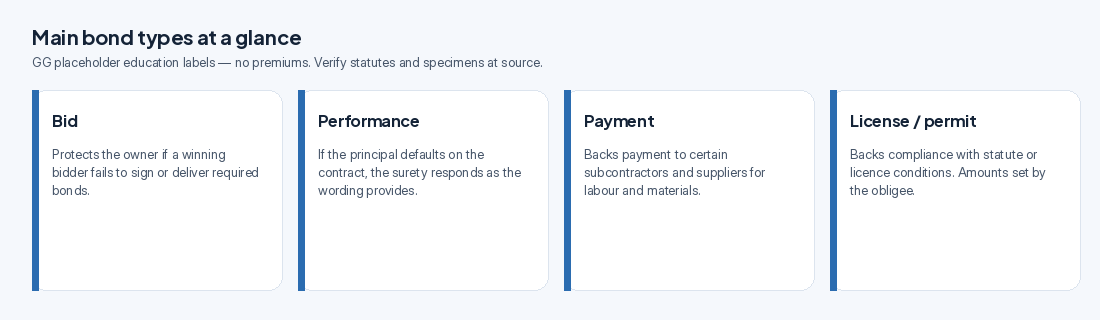
Surety splits into contract bonds (tied to a construction or supply contract) and commercial bonds (licence, court, fiduciary, public official, and related undertakings). The types that dominate desk conversations:
Bid bond — protects the owner if a winning bidder fails to sign the contract or deliver the required performance and payment bonds.
Performance bond — if the principal defaults on the contract, the surety completes the work or otherwise responds as the wording provides (arrange completion, fund completion, or pay a covered loss up to the penal sum). Exact options live in the specimen.
Payment bond — backs payment to certain subcontractors and suppliers for labour and materials. On many US public projects, performance and payment travel as a pair. Federal public works above a statutory threshold have long required payment security under the Miller Act (and state “Little Miller” analogues). Industry education commonly points to the FAR / Miller Act class around $150,000 for covered federal construction — verify live 40 U.S.C. §§ 3131–3134, FAR 28.102-1, and the solicitation before you brief anyone.
License, permit, and other commercial bonds — many jurisdictions require a bond (or cash / bank LOC) before a business may operate. The bond backs compliance with statute or licence conditions. Amounts are set by the obligee, never invented by this site. GG’s wordings slice (AMVIC, driver-training provinces, California dealer analogues, and more) exists so you can read those public forms — re-verify amounts on the regulator’s live page.
Same three-party skeleton across commercial subclasses; different statutes. For how the printed promise is structured, see Bond wordings from public specimens.
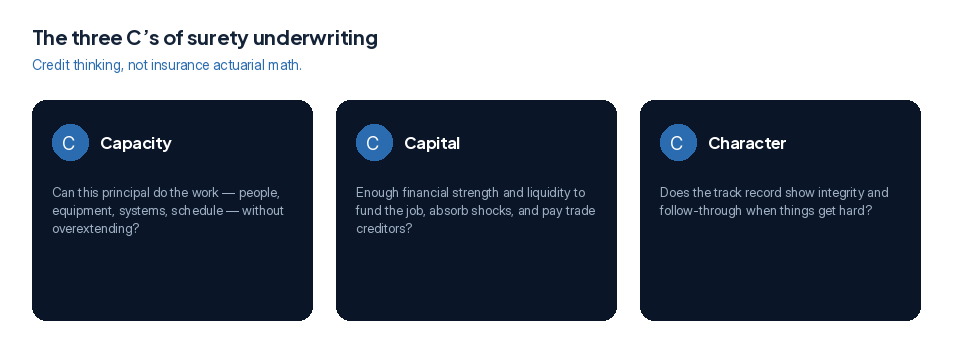
Surety underwriting is closer to extending credit than to pricing a car-insurance book. Public NASBP education describes the surety examining financial strength, experience, work in progress, management, and character before deciding whether — and how much — surety credit to extend.
Desks often compress that review into three education labels:
| C | Plain question |
|---|---|
| Capacity | Can this principal do the work — people, equipment, systems, schedule — without overextending? |
| Capital | Enough financial strength and liquidity to fund the job, absorb shocks, and pay trade creditors? |
| Character | Does the track record show integrity and follow-through when things get hard? |
Those are orientation labels, not a scorecard from this page. Global Guarantors does not publish premiums, “approval odds,” or carrier rankings. For who publicly lists which classes, use the living underwriters roster — then verify on the carrier’s own pages. Pipeline and instrument choice (bond vs bank LOC) are expanded in the Underwriter desk pack.
No claim playbooks here. When money, deadlines, or notice rights are live, use the actual bond, the contract or statute, and qualified counsel in the right jurisdiction.
The three-party idea travels; form families and percentage norms often do not. Canadian construction commonly uses performance plus labour and material payment bonds (CCDC / Surety Association of Canada public education — e.g. CCDC 221 / 222 in current materials). Penal sums are set by the tender documents, not by a US habit of “100% each.” Provincial prompt-payment and holdback regimes sit beside surety — they are not substitutes for reading the bond. License and permit bonds are widespread provincially; the obligee sets the amount.
Deep dives: Canada prompt payment (Ontario & BC) · Ontario construction holdback. This primer stays US-first on purpose.
Global Guarantors is an educational reference hub around three first-class products: bond wordings (/wordings/), a living underwriters roster (/underwriters/), and Education primers like this one (/education/).
Not: a brokerage or placement desk; a premium quote engine; legal, claims, or underwriting advice; a membership association or CPD provider; or a substitute for the live statute, solicitation, or issued bond. If a figure is not on a dated public source we cite, we do not invent it. Thin facts stay Pending.
No continuing-education hours on these cards — Learn tracks into GG’s own primers and databases only.
Public educational and government primers (retrieved 2026-09-30 unless noted). High-level cites only; no copyrighted full bond text.
