
What Ontario already requires for prompt payment and adjudication — and where British Columbia stands (Royal Assent, not yet in force).
Last verified: September 28, 2026 (PT)
Part 1 of a Canada payment-law series. Later posts can cover other provinces and federal rules as needed.
This page is an education-first briefing for brokers and surety professionals who support Canadian contractors and owners — and for US readers with cross-border books. Payment-timing statutes change when cash moves down the construction pyramid and how quickly a payment dispute can leave negotiation and enter a formal determination. That can interact with labour-and-material / payment-bond claim timing. The goal here is status and watch-outs, not claim strategy.
Verify at source / not legal advice. Legislation and regulations change. Always confirm in-force status and exact wording on odacc.ca, ontario.ca (Construction Act), gov.bc.ca prompt payment, and BC Laws before relying on any timeline on this page. Global Guarantors Learn content is general industry education — not legal, underwriting, or claims advice. Construction payment, lien, and bond rights are jurisdiction-specific; use qualified Canadian counsel.
Faster statutory payment clocks and short adjudication windows change when money is supposed to move — and how quickly an unpaid trade can get an interim decision instead of waiting on court or arbitration.
That matters for surety work because payment timing can change when unpaid trades look to a labour-and-material / payment bond, and how quickly a dispute hardens into a written determination. Faster cash-flow rules do not rewrite bond conditions, but they can compress the calendar around notices, investigation, and negotiation.
This page maps:
It does not prescribe claim steps, invent interaction scenarios, or substitute for counsel or bond-form reading.
Ontario’s construction statute has required prompt payment of proper invoices and offered interim adjudication since October 1, 2019. Further amendments came into force January 1, 2026. Those updates tighten how invoices become “proper,” widen when and how adjudication can be used, and change holdback release practices.
Primary anchors: ODACC — Prompt payment, the Construction Act, R.S.O. 1990, c. C.30, and ODACC’s adjudication process pages. Ontario Dispute Adjudication for Construction Contracts (ODACC) is the Authorized Nominating Authority that administers the adjudication system.
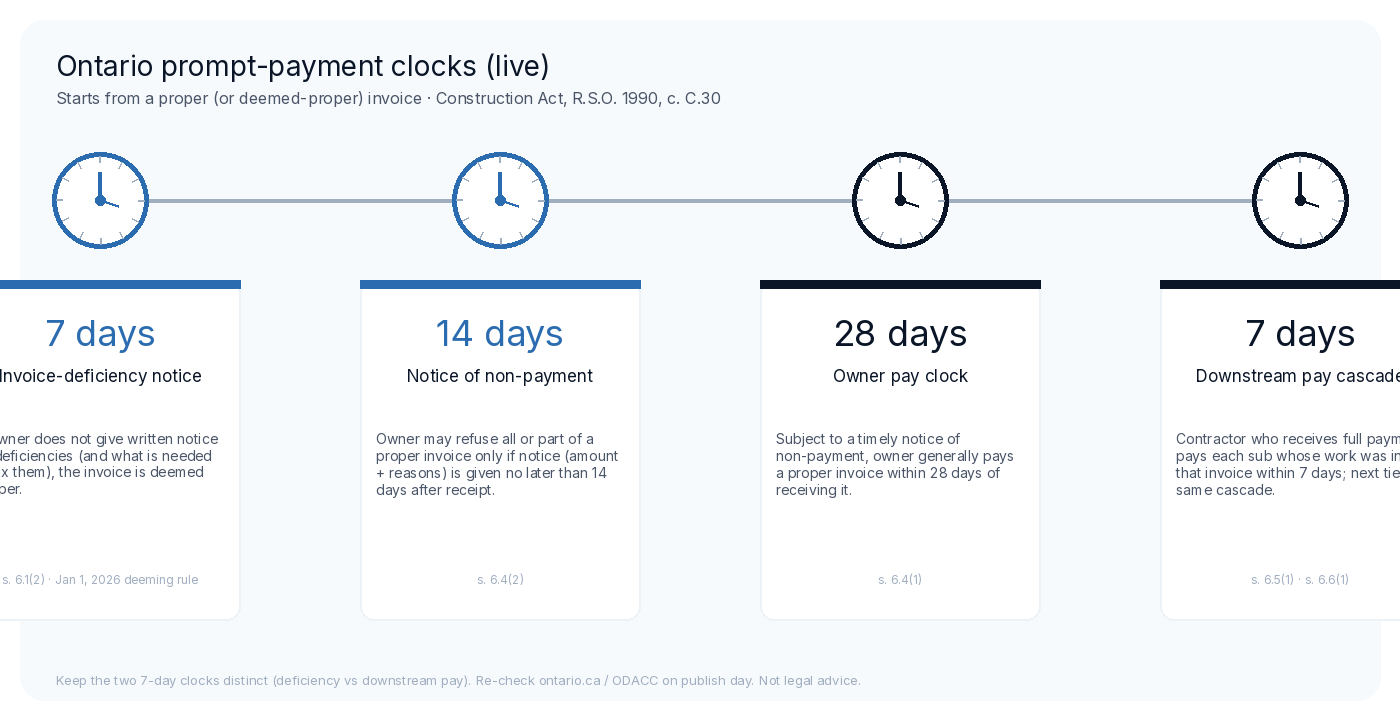
Think of the system as a short set of clocks that start when a contractor delivers a proper invoice to the owner:
| Clock | Plain meaning | Keep distinct from |
|---|---|---|
| 7-day invoice-deficiency notice | If the owner does not give written notice of invoice deficiencies (and what is needed to fix them) within 7 days of receiving the invoice, the invoice is deemed proper even if it was formally incomplete. (Jan 1, 2026 deeming rule — s. 6.1(2).) | This is not the notice of non-payment. |
| 14-day notice of non-payment | If the owner disputes all or part of a proper invoice, it may refuse payment if, no later than 14 days after receiving the proper invoice, it gives the contractor a notice of non-payment (amount not paid and reasons) — s. 6.4(2). | Separate from the 7-day deficiency clock; both can run at the same time. |
| 28-day owner pay clock | Subject to a timely notice of non-payment, the owner generally pays a proper invoice within 28 days of receiving it — s. 6.4(1). | Starts from a proper (or deemed-proper) invoice. |
| 7-day downstream pay | A contractor who receives full payment within the owner pay time shall, no later than seven days after receiving payment, pay each subcontractor whose work was in that proper invoice — s. 6.5(1). The next tier has the same seven days after receiving payment cascade — s. 6.6(1). | Do not conflate with the 7-day deficiency notice. |
2026 deeming rule (must-watch for this series opener). Under section 6.1(2) of the Construction Act, an invoice that does not meet the formal “proper invoice” requirements is still deemed a proper invoice for prompt-payment purposes unless, no later than seven days after receiving it, the owner notifies the contractor in writing of the deficiency and of what is required to address it. Silence past that window generally starts the payment clock on the invoice as delivered. The owner can still dispute amounts through a timely notice of non-payment — the deeming rule targets invoice form/content objections, not every payment dispute.
Section cites (Advisor-verified): The clocks above map to Construction Act s. 6.1(2) (deeming), s. 6.4(1)–(2) (28-day pay / 14-day notice of non-payment), s. 6.5(1) and s. 6.6(1) (7-day downstream cascade). Still re-open ontario.ca or CanLII on publish day in case the Act is amended again.
Official notice-of-non-payment forms (the Form 1.1 / 1.2 / 1.3 family and related Construction Act forms) live on Ontario’s court forms site — link them; do not treat this page as a forms manual: Ontario Construction Act forms.
Adjudication is a fast, interim decision process for certain construction payment (and related) disputes. In plain terms:
January 1, 2026 adjudication updates worth knowing:
Pending verification (determination pay clock): ODACC’s live Adjudication process page states payment within fifteen days of the determination. Some older firm explainers still cite 10 days (the prior clock). Prefer ODACC and the current Act section 13.19 text at publish; treat any conflict as a reason to quote the statute, not a blog.
The January 1, 2026 amendments also change holdback practice, including a move toward mandatory annual release of accrued basic holdback (with related notice and lien-timing mechanics). That topic deserves its own Learn post. For Part 1: know that holdback timing changed alongside prompt payment — and plan a separate holdback explainer rather than treating annual release as a side note here.
HARD FLAG — Re-check before publish (dated September 28, 2026 PT):
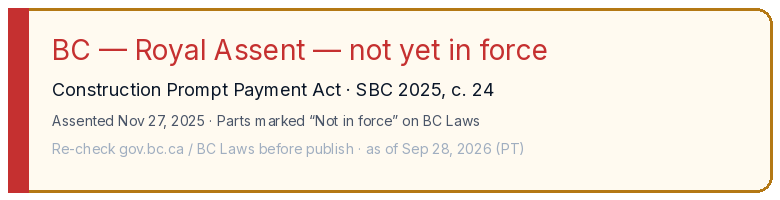
British Columbia’s Construction Prompt Payment Act received Royal Assent on November 27, 2025 (SBC 2025, c. 24) but is not yet in force. The Province’s plain-language page (last updated August 20, 2026) and BC Laws both show the operative Parts as “Not in force.” Commencement is by regulation of the Lieutenant Governor in Council after regulations and an adjudication authority are in place. Do not describe BC prompt payment as live law. Re-verify gov.bc.ca, BC Laws, and industry status pages on publish day — and again before any client-facing quote of in-force status.
BC has passed a prompt-payment statute. It has not proclaimed it. Until proclamation:
The Ministry of Infrastructure’s plain-language page describes a design similar in spirit to Ontario’s model:
Treat that as the Province’s public summary of future rules, not as operative law today.
Education-level watch-outs only. No claim playbooks. No invented scenarios.
Faster statutory payment and short adjudication windows can surface non-payment earlier. That may accelerate when a trade considers a labour-and-material / payment-bond claim. It does not rewrite the bond. Point clients to the bond conditions, notice requirements, and qualified counsel — do not improvise claim steps from this page.
Ontario’s regulations also address adjudication in relation to certain labour-and-material payment bonds (see ODACC’s commencing-an-adjudication guidance and O. Reg. 264/25). That is a process-availability note for surety professionals to be aware of — not a how-to.
Under prompt-payment regimes, proper invoice content and timely notices of non-payment matter more. Brokers can educate clients to keep invoice and notice trails clean (what was sent, when, and what written responses came back) without giving legal advice. The 2026 Ontario deeming rule in particular rewards owners who calendar invoice intake carefully — and contractors who can show what was delivered.
US underwriters on Canadian work should not assume US Miller Act timing or bond-percentage norms. Pair this page with Global Guarantors’ Learn piece on megaproject / data-center performance security for the US ~100% vs Canada ~50% bond-size comparison. Payment statutes and bond-size norms are different tools; both are jurisdiction-specific.
Watch for:
Until those land, treat BC like a coming regime, not an Ontario twin.
This section does not:
Primary sources lead. Firm and association pages are secondary orientation only.
Research date: September 28, 2026 (PT). Re-check every Pending verification item and BC in-force status on publish day.
